By David J. Knight
Enter an ancient art museum, and you will find yourself looking at old human artifacts, wondering, Who were these people? What was life like for them? What were their struggles, hopes, and fears? It was strange, then, for me to ask these same questions as I walked through a South Side warehouse filled with discarded furniture from the 2013 Chicago school closings.
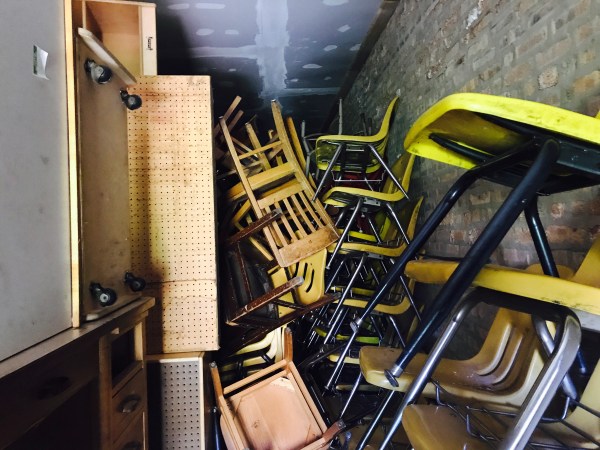
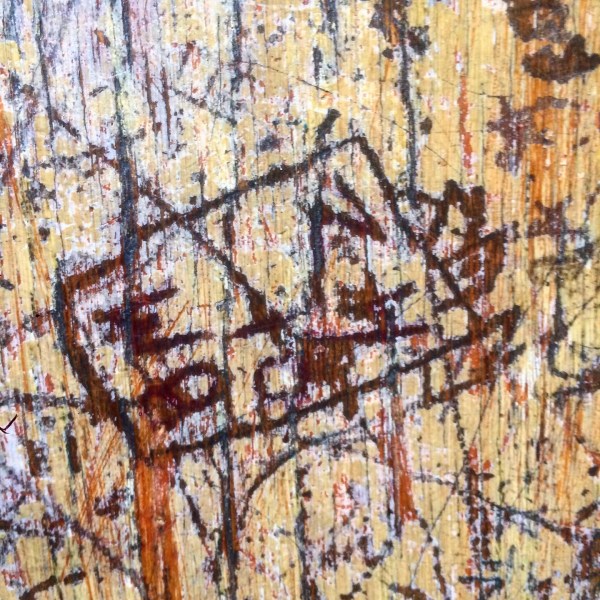
Hundreds of desks, tables, and bookshelves were stacked from floor to ceiling. Countless little yellow chairs, designed specifically for eager, energetic children, were piled high. These materials had no doubt been used, inhabited, for many years. As with all things, human activity leaves its traces. Wornout labels made by teachers were still stuck to the sides of bookshelves and cabinets, evidence of the care taken to expand the knowledge of young minds. Peculiar etchings made by students were carved into tables and desks—some purposefully, perhaps out of frustration or boredom, others unknowingly from generations hardpressed pens on the writing surfaces. Generic stamps from Board of Education also remained on the backs and undersides of this furniture, denoting district ownership of the equipment. All these markings represented, quite visibly, the broader range of the interests, experiences, and aspirations historically present in Chicago’s public school system.
Once referred to as “the worst in the nation” by then Secretary of Education William Bennett in 1987, the Chicago public school system has long epitomized the difficulties of urban education. The concentration of largely poor African American families into highrise housing developments , such as the CabriniGreen and the Robert Taylor Homes, in the mid20th century meant that students were necessarily clustered into schools divided by race, class, and location. This racialized public housing strategy pushed segregation in the city into another dimension, where race, place, and poverty intersected even more dramatically in the lives of many Chicagoans. Starting in late 1990s, however, the decision to tear down the highrises and move people out of the
projects left many of the nearby neighborhood schools underenrolled. Over the next fifteen years, the city and district made significant plans to close or reorganize many underenrolled schools. The most drastic measure was the Chicago Board of Education’s vote to close 49 schools in 2013.
The vote of the Board came after months of intense debate in the city over equity and public schooling. The stakes were high. As reported by the Chicago Tribune, the district was facing a “massive budget deficit,” as well as trouble effectively distributing its resources. Downsize, officials urged, and consolidate the underutilized schools. But deeper concerns over racial inequality arose from the fact that the school closings were slated to disproportionately impact black students on the South and West Sides of the city. Public hearings, marches, and demonstrations were held. Much of it made national news.
In the end, the Board voted 60 vote in favor of the closings.
Close to 12,000 students were displaced. Countless families were affected. And according to a report by the Chicago Teachers Union, one in four public schools with majority black students and staff was closed or taken over by the district during this time.
Also consider the backdrop: These school closings took place in communities where, the Chicago Catalyst reported, more government funds were spent on incarceration than on schools in the decade leading up to the closures.
Nonetheless, the district’s policy dictated that family and caregivers of students in closed schools would have to evaluate where to send their children. As parent Ronald Brooks told the Chicago Tribune, experiencing the closure was “traumatic to say the least.”
Looking back years later, many questions remain open
What has happened to the students, teachers, families, and communities in and around these schools? What would have happened had the schools remained opened? What was sacrificed in the school closings—and how great were these sacrifices? What might have been salvaged? Which aspects of community may have been activated by the closings? Were the closings worth it? And who gets to decide the answer to that question?
There are few clearcut answers to these questions. We’re still processing the events. And if this exhibition’s featured materials—unexpectedly saved from the landfill—are any indication, knowledge of the impacts of these events can be elusive.
One thing is clear, however: the deepseated complexity of problems, concerns, and histories impacting public education in Chicago remains and was in no way resolved by the shuttering of schools. This broader context should not be forgotten amid the controversy.
The material culture of these closed schools stands as an enduring reminder of this broader context—that generations of students and teachers moved through these spaces, and infused these spaces with their own energies, resources, and ambitions. Parents and communities further contributed to this collective effort.
True, the circumstances in a number of closed schools may not have been perfect. They never are in any setting. But this does not mean that these places lacked goodness, however fragile. Nor does it mean these schools lacked knowledge and vision for what educational justice should look like for Chicago’s youth.
—
One might say, then, that the materials and creations in Infinite Games 50/50 address the fragile history of these schools and the impossibility of ever truly knowing the full significance of the 2013 school closures. We will never know precisely how everyone was affected, nor how they each coped with challenging realities in the city. The simple fact that these materials—nearly all of which are still usable and useful—were almost thrown into a landfill only underscores our own ignorance of pressing issues and the shallow nature of public awareness.
It also reflects our tendency to make the easier choice: to discard and then ignore that which requires repair and greater investment. But the problems of race and inequity in the city and nation, difficult and unsettled as they are, cannot be discarded in such a manner. The physicality of these rescued materials therefore serves as a caution. Many of our stories are forgotten or never told. This is especially true for the most vulnerable among us. These stories are often ones of injustice and displacement, trauma and resistance. But systems are too often not designed to acknowledge or receive this wisdom. Decisions are still made, though, and become part of the official history.
The art in this exhibition opens up the debate about the school closings and about equity in Chicago to other possible conversations—conversations that go beyond the rigid frames of good and bad, right and wrong, success and failure. In so doing, we are able to further reflect on the people who were directly impacted. We are asked to imagine their experiences and our own positionality, and we are presented with alternative means of repair that conserve goodness while also inviting social critique.
—
One clear example is textbased artist Teresa Pankratz and art practitioner Bryan Saner’s interdisciplinary piece “The Writing Table: Here, Like A Star.” The piece speaks to the multidimensionality of issues that come together in the school closings, and to the ways in which certain stories and experiences are not readily visible. A collaboration with fiber artist Karen Reimer, Pankratz and Saner’s reclamation and reworking of this table serves as a way to “recognize the lives of the people who sat there.”

Generations of crayon, pencil, and pen markings line the graphite wood of the table. Bearing witness to the unnamed youth who left these marks, Pankratz and Saner build the narrative around a young student, Star, who struggled to keep her school open. But the story goes beyond that. On the underside of the table rests the imprint of the unionized woodworkers who made this table, juxtaposed by a stencilsprayed stamp of the Chicago Board of Education, which was dated 1951. Education, economics, and labor all converge across time in this simple fourlegged piece of equipment.
One of their aims, says Pankratz, is to gather people around these narratives and connect people viscerally to these texts. They burnt stars onto select parts of the table wood as a way to focus people’s attention on the different hands that worked and used the table. In turn, our way of seeing the table changes with what we read and with the different perspectives we take.
In the end, Pankratz and Saner also write their own story onto the table, both creatively and literally. They utilize the legs and screws of several other tables as a means of valuing each artifact. Onto the table they also write the poetic narrative of Star, and conclude with their own parenthetical response that “It’s time to turn the tables.”
Sculptor Titus Wonsey takes a different, though no less challenging, approach. He surveyed his friends and family about their experiences with the public schools, space, and mobility in Chicago. Narrowing in on the themes of social abandonment and erasure, Wonsey uses furniture pieces from the school closings as the skeleton for a Stonehengelike soap sculpture.
Erasure and residue are prominent themes in this work. Wonsey explores what happens to a place when it is abandoned, and what becomes of our relationship to it. And so, because of its physicality and rectangular, monolithic form, his soap sculpture is able to serve a practical cleansing function within a shower while also challenging the very process of which it is a part.
Wonsey’s monolithshaped soap sculpture forces us to confront our own attempts to erase or wash our hands of dirty and difficult things. But, however inconvenient it is, some things cannot be erased or washed away. What do we do with the residue? Wonsey asks. How do we deal with what’s left?

Small but powerful creations complement the sculpture. After finding an old student roster in the drawer of an abandoned desk, Wonsey set out to make hand towels onto which he imprinted these students’ first names. This artistic gesture remixes uppermiddle class customs of initialing one’s hand towels by recognizing by name students who would otherwise be anonymous in the process of the school closings.
—
These artistic pieces are part of a significant collection of conceptual and experimental creations in Infinite Games 50/50. But unlike so many works, sectioned off in museums and galleries by velvet ropes and “Do Not Touch” signs, these creative works serve a functional purpose. The pieces in this exhibition are meant to be used and appreciated in daily life. They represent a collective, creative response to deep uncertainties in Chicago. Instead of offering conclusive judgments on the 2013 school closings, these works pose questions to us and recenter our attention on the human beings who inhabited the furniture within the closed school buildings. We are asked to imagine what these people’s lives were like, what their hopes and fears were, even as we realize the limits of our own understanding. We are required to confront the human element; we must acknowledge the people—especially the young people—who learned and grew up in these spaces. And as a result, we are challenged to think more imaginatively, and I daresay more radically, about what has goodness and value in this city—and about alternative ways of repairing or reusing what might otherwise be abandoned.
In this sense, Infinite Games 50/50 is an invitation. We are invited to enter a more expansive, creative space in which to grapple over unresolved issues of space, equity, and recognition in our city. Instead of asking “So what?” of the school closures and
other crises in Chicago, we are encouraged to wonder “What if?” That change in perspective could make all the difference.
David Knight is a writer, educator, and scholar who is based in Chicago. He is currently completing his PhD at the University of Chicago. His program of research focuses on the politics of displacement, race/ethnicity, young adulthood, and educational justice in the city. His previous work has appeared in The Washington Post, The Atlantic, and the Harvard Educational Review.
 JOHN PREUS