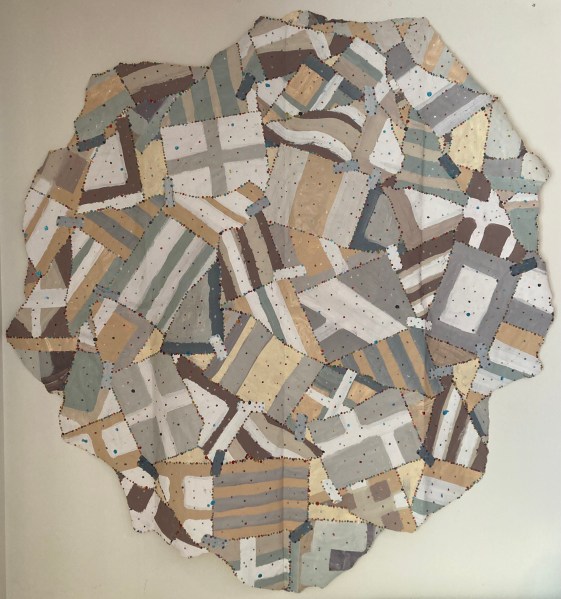
“The Least Among Us” at Nemeth Art Center, Park Rapids, MN
May 1-31. Artist reception: May 23, 4-6 pm
Daniel Kerkhoff has amassed a fairly large body of unique and novel experiences with multiple trips to Ghana, Vietnam and Ecuador, along with his community work in North Minneapolis and Mankato, where he sets up ad-hoc residencies to provide himself the economic freedom, time, and space to engage as much as a citizen in the community as possible. Because he makes much of his work abroad, he has become familiar with folding things that won’t fit in a suitcase, at first a necessity that he later embraced as a working strategy, folding and unfolding and using the creases as aesthetic choices. Many of the works from “The Least Among Us” are 4 to 5 feet in diameter, mixed-media works on paper (glitter glue, latex house paint, ink, tape) that have associations with a mandala, a patchwork quilt, a pastry, nomadic parchment, even aerial landscape photography. The collages appear stitched together by virtue of meticulous patterns of painted and drawn dots and dashes with an occasional found object, and soil from the landscapes themselves incorporated into constellations of memory and experience understood as cosmic patterns that give order to the rich chaos of the world, like notches on a doorpost to mark our growth.
Many of the works are titled as statements, or calls to conscience, like “The Rooster is Crowing in the Streets,” or “Lying in the Naked Truth,” or, my favorite, “Whitewashed Locusts of Exclusion.” Like the title of the exhibition, “The Least Among Us,” Kerkhoff places his primary concerns front and center: how to be a servant to humanity, how to share his gifts and privileges with people less economically fortunate, and to call out injustice where he sees it. But rather than simply paint about his social and political values, Kerkhoff has devised a system based on barter and a Spartan existence to put himself in places where he feels he can be of service and grow from his interactions with other cultures, trading a bed to sleep in exchange for conducting drawing workshops for =street kids, or contributing to libraries expanding access to valuable information that we take for granted in the U.S.
One lens through which to consider Kerkhoff’s work is through the lineage of Social Practice, which came into view in the early 2000s, birthed in part from the impulse of Joseph Beuys and his concept of Social Sculpture, combined with the emergence of Relational Aesthetics. They relate in how they privilege the interdependency of both the art-making process and the objects themselves which, rather than isolated and discreet objects are suspended in a field of value. Rather than isolating themselves in monastic studio practices, Social Practitioners could be seen starting soup kitchens or undertaking some kind of social service and then filing it under Art by way of performance art. This development further expanded the field of art such that anything and everything, granted the proper framing, could be imagined as an artistic gesture. The ecology of social, political and physical structures that we find ourselves in is reimagined through a poetics of space, to borrow a phrase from Gaston Bachelard. How can we imagine a “right” relation between the various spheres of human interaction and consider them as a malleable form rather than a static inheritance to which we submit ourselves like caged animals? Where are the cracks in the existing physical and social structures that could let in some light?

When artists begin to imagine their “material” as the social fabric rather than a handful of clay or pigment, a novel set of questions and problems emerges. We can’t ethically imagine people as material to be manipulated (which is not to say it doesn’t happen regularly). But there is a value to understanding social life as a form, a shape, and one that could be otherwise. Social policy seen through this lens is good or bad poetry depending upon its impact on the human soul. Joseph Beuys was an anthroposophist, a devotee of the mystic philosopher Rudolf Steiner who was responsible for the emergence of Waldorf Schools, biodynamic farming, participatory economics, the Christian Community church, and maybe most relevant to our topic, the Threefold Social Order. As illustrated in a Venn diagram, “threefolding” describes the practice of balancing three distinct spheres: the economic, the political, and the cultural. Among his critiques of the social climate, which is more true now than it was in the early 20th century when he was writing, is that the economic sphere had become too dominant and had corrupted the freedom and integrity of the other spheres. He understood the predominant forms of government as an imbalance of one sphere over another:
- Theocracy, in which the cultural sphere (in the form of a religious impulse) dominates the economic and political spheres.
- State Communism and state socialism, in which the state (political sphere) dominates the economic and cultural spheres.
- Traditional forms of capitalism, in which the economic sphere dominates the cultural and political spheres. (from wikipedia)
Kerkhoff’s work could be imagined as a practice of threefolding, in which his aesthetic production is informed by but independent of his politics and his economic life. He makes work outside of the standard art support mechanisms — the art market, the pursuit of art grants, the residency circuit — to allow for more unencumbered production according to what moves him personally in direct response to his intercultural communal life. Seen through the threefold lens, Kerkhoff’s works, the shapes, the form, the layering, the “stitching,” the use of soil from the places in which he is working takes on a conjuring character, a longing to incorporate the richness and difference of these interwoven spheres into a coherent, balanced, and harmonic ecosystem.

Among the critiques of social practice is the fact that there’s a reason it takes an organization to perform certain services. For a social service to be valuable, it has to be predictable, dependable and efficacious, and rely on something more rigid than the motivations and goodwill of a single individual, however earnest their intentions. One metric of the benefit of some social endeavor might be to ask, what does it promise in comparison to what it delivers? No doubt, such questions have surfaced at various points for Kerkhoff, and have inspired artists like Rick Lowe and Theaster Gates to buy real estate as a more direct impact on social service gaps; Amy Franceschini , Claire Pentecost and Brian Holmes to take up farming or political action to address issues of food supply, and the health of the soil; or the collective WochenKlausur to undertake humble but direct civic actions that fall through the cracks of larger and less nimble social support institutions.
There is value in the artistic objective of bringing attention to some social ill, or critiquing existing systems and values. But the social service administrator would not be wrong to ask, have your paintings about homelessness resulted in a single homeless person finding a place to live? Even if such questions are a kind of moral blackmail they have still chased many an artist out of the studios and into activism, political action or advocacy of some kind. But not Kerkhoff, who maintains a prolific studio practice informed and inspired by his social and economic activity.
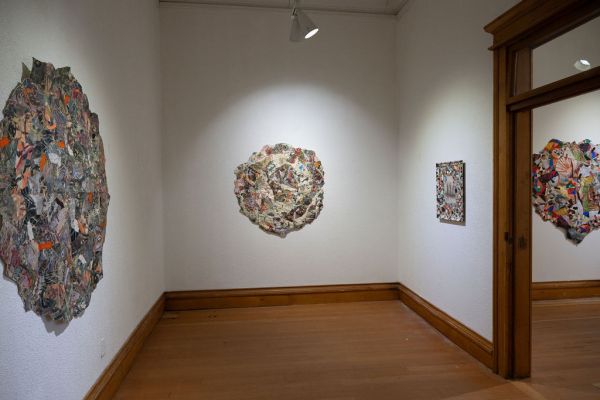
Kerkhoff understands his varied endeavors as interconnected systems that inform each other. An artist consumes an experience that rattles around with all the others in there, from which an object emerges into the physical world, and from out there penetrates the interior of another human being as value. This complex engine of social evolution runs on some alchemy of familiarity and difference, first seducing us in then surprising us upon deeper reflection. Kerkhoff’s work has a glancing resemblance to a wide variety of other things in the world, many of which have some connection to memory, to time, to cataloguing the significance of an experience as a vessel. Neurologists warn us that the repetition of the same thoughts carves a physical groove into the tissue of our brains, and to avoid dementia or just living out a cliché of oneself and all of its attendant suffering, they urge a commitment to novelty which irrigates the backwaters of our minds, opening us to a deeper awareness of ourselves.
An artwork that can incorporate the political and the economic without being corrupted by them can be appreciated purely in aesthetic terms, free of any knowledge of its political commitments. And while the titles of the works certainly show his cards, politically speaking, Kerkhoff composes objects that hold that complexity in their visual DNA and can be absorbed and appreciated independently while being enhanced by the depth of his commitments beyond the studio. At times introducing materials, colors, or techniques into his work that he does not like to challenge his own preferences, Kerkhoff’s process demonstrates an awareness and commitment to the social, composing in his studio while composing in the world folding, unfolding, and refolding self and other.
 JOHN PREUS