Park Rapids, MN
May 1-31. Artist reception: May 23, 2025 4-6pm
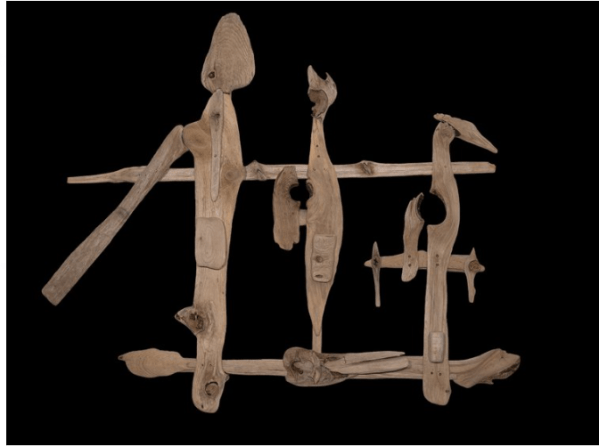
In The Deep Dreams of Roots, Jesse Dermody invites us to observe his wall and floor pieces made from scavenged driftwood collected near his home in Duluth through the lens of the dream. As a total body of work, it has a consistent mood and tone, a resonant hum like the residue of a dream that leaves you feeling that you spent time with someone and it felt nice but you can’t remember who it was. In the popular vernacular, dreams — as in, “I have a dream” — is meant as a thing to work toward, a shining future possibility, or a simile for imagination. But most dreams, the kind we have when we are sleeping, are not like that. They are disjointed pictorial and emotional landscapes in which all manner of entanglements, anxieties and visions play themselves out. Whatever wisdom might be buried in them requires excavation by careful attention and open-heartedness.
I recently fell asleep with a podcast playing next to me and in each setting encountered someone who was saying wise and profound things but couldn’t seem to stop talking. I entered a sort of opium den with people lounging around on cushions and smoking long pipes, among them a woman who had contracted this wisdom-vomiting epidemic. I approached her, looked into her cloudy eyes, shook her by the shoulders and said, “Stop talking! Stop talking!” “Stop. Talking.” She went into a fit of convulsions as I held her shoulders and then came back to her senses. She and her friends thanked me, she placed my hand on her breast in gratitude and then lit up her pipe. I left feeling empowered only to be disappointed that it didn’t work on anyone else I encountered. I awoke with both a feeling of accomplishment and disappointment that I hadn’t completed the task.
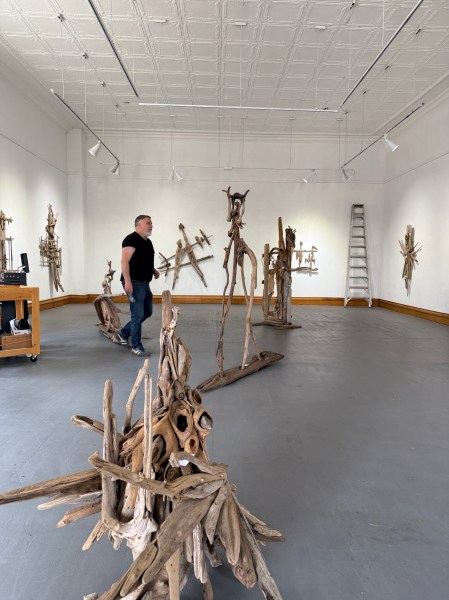
There is already a deep and profound beauty in the sticks themselves, carved, bleached, hollowed, enchanted by the elements and leaving Dermody to elaborate. Whatever it is that the sticks could say themselves is generally lost to the wilderness. Does nature know its own beauty? Does it need humans to elaborate upon it? By invoking the dream, Dermody’s driftwood is granted a will and an imagination, along with the anxiety of indecision.
Driftwood as an art and craft material most often involves taxidermy, fairy houses, wizard’s staffs, little perches for a carved bird to sit on, and so forth. Or in the modern art world, we have Deborah Butterfield and George Morrison, which gives us a sort of material continuum. Dermody has symptoms of both pathologies — I mean that in the best way — the methodical, puzzle-like piecing-together aesthetic of Morrison, as well as the organic, letting-it-be quality of the driftwood pieces in Butterfield’s work.
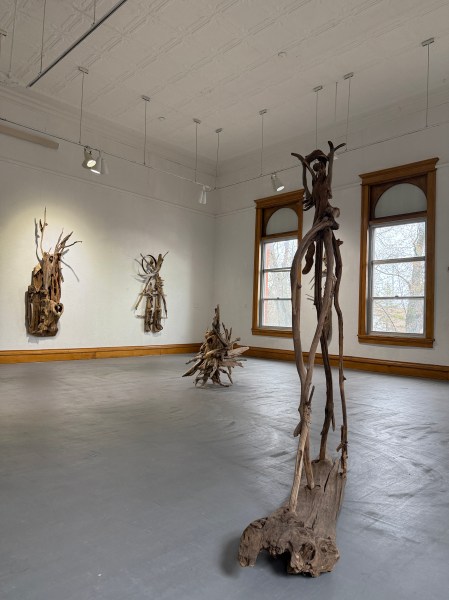
The archival human impulse to arrest things at a given state of organization, seen from the perspective of cosmic time, is a flash in the pan, a hiccup in the space-time continuum before earth mother reclaims her quarry. The names we give to things is always a snapshot of a broader morphology, as Levi-Strauss points out in The Raw and the Cooked. What we call a carrot is the brief moment when it is a long, orange, edible stick. But we call the vessels sitting on shelves at Home Depot “toilets” even before they are serviceable as such. If Marcel Duchamp had his way, maybe we would call them “fountains” or “candidates” since they can’t yet perform their intended function, never mind that someone has tried more than once to make use of Duchamp’s facilities. All of which is to say, the names we give to things is often driven by function, and function by time, and time by a desire engine churning away, endlessly elaborating upon and editing its creations. Evolution seems to want to go somewhere other than where it is but rarely to marvel at its own labors. Maybe that is what we are for, and what Dermody allows with his tangles of sticks.
Dermody’s title invokes a will at work in the evolution and development of the natural world. For roots to dream would require desire, which further suggests an intention, a toward-which, a destination, an attractor at the end of time calling a particular form into being, all of which would be irrelevant if it were not possible for it to be otherwise. Longing exists reciprocal to the potential of non-fulfillment. And the minute desire enters into the equation of natural forces, so does preference. There are good dreams and bad dreams. Mirages and nightmares. Hopes and delusions. What kinds of dreams are these bits of driftwood having?
The dream of an oak tree is present in the acorn, to paraphrase Aristotle, and their reveries can be cut short by an enterprising squirrel. But a squirrel is probably not suffering a crisis of conscience having done so. We encounter all manner of complications the minute we try to attribute human values to the natural world. Orcas don’t repent for ruthlessly flinging baby seals around for their perverse pleasure and are unlikely to be called out by another orca with a more developed conscience for doing so. But who knows? Maybe it’s only the Jeffrey Dahmers of the orca world that behave so callously and we paint them all with the same brush for lack of knowledge.

According to Butterfield, driftwood dreams only of horses, but through Dermody’s hands, it finds itself in the grip of a more tumultuous sort of dream, like standing on stage trying to find your notes for a presentation only to realize you forgot to wear pants. Or the kind in which you are trying to fit things into a container that is not the right size or shape. But like all great works of art, they give the impression of having evolved to be that way, like a ripe carrot in its moment of edible glory, or a magnolia tree in its burst of erotic flowering.
And what remains to us, the observers, is to manifest the dream. The artworks sit silent and unseen in an unlit room except for the moments of attention that we bring to them, like digging a piece of driftwood out of a creek and turning it over in your hands imagining what sort of thing it could be. A river washes thoughtlessly over branches that fall carelessly into the water, which acts like an accidental paint brush making things needlessly beautiful as it rushes off toward a larger body of water with no thought of doing otherwise, nor resting to admire the fruits of its labors. When Dermody plucks the branch out of the creek and reconfigures it into “Vera,” all of that energy is resolved into a temporary word, a moment of logos when nature gets to see itself, however briefly, through the consummation of our attention.
 JOHN PREUS