
Nathan Vincent’s “Locker Room”/Photo: Steven Miller for Bellevue Arts Museum, WA
Expo can be a wonderfully overwhelming experience, a firehose of great art and programming that brings everyone in the Chicago art scene out at once. I enjoy having my retinas accosted with novel and compelling imagery softened by the warmth of feeling a part of a broad, unique and dynamic community of artists and thinkers. But that is not necessarily what everyone will experience. The social saturation and people-watching dimension dies down a bit after the first big opening event so that the art itself can resume focus. But despite spending three hours at the Vernissage, I managed to visit maybe one third of the booths on display, so my Top Five is a percent of a percent. Here’s what caught my attention in the time I was there.
5
Edra Soto at Engage Projects, Chicago, Profile Booth 241
Disclaimer: Edra Soto is an old friend and collaborator on a variety of past projects, so I have had the pleasure of watching her work morph and transform into a familiar but ever-changing language of forms and materials based on her personal story and Puerto Rican heritage. But rather than recuse myself, I will acknowledge my bias upfront and you can judge accordingly. Soto has transformed a set of standard-issue plastic lawn chairs into plush, upholstered image-saturated objects, surrounded by small elaborations on her larger “Graft” series produced in partnership with her talented husband, Dan Sullivan. The textiles printed with graphic pop representations of among other things, the Puerto Rican rapper Bad Bunny, have the appearance of beach towels but feel more like velvet if you can get away with touching them when the personable gallerists aren’t looking.
But the stars of Soto’s installation in my view are the designer fans in which the covers are made of richly colored and elaborate screens. I am ushered into the perennial debate over where to devote our cultural and creative energies as expressed through movements like the Bauhaus ideal in which every object we encounter is thoughtfully and carefully considered. Does such attention to detail generally make life a little better if every gas pump handle and floor drain is a “piece” so to speak, worthy of our attention and contemplation, or does that render us the inevitable victims of a barbarian invasion from a more spartan and resilient culture weaned on tragedy, conflict and upheaval? Such are the internal tensions under which empires fall. But in the meantime, plush lawn chairs and designer fans express an exuberant celebration of the rich and ethnically diverse culture we are fortunate to inhabit.
4
Nathan Vincent “Locker Room” at Walter Maciel Gallery, LA, Profile Booth 343
I admit to generally being bored by work that embraces a certain logic and follows it out to its familiar conclusion in some unexpected material—the corporate office made of wood including the power cords, the machine shop rendered in wax, a janitorial closet rendered in bird feathers… I am often more compelled by how multiple, equally true but competing logical frames get interwoven and overlapped with each other. But this installation seduced me into the locker rooms of my youth. Would the softness of a crocheted environment be enough to overcome the impulses of jockish bullies with their snapping towels and vulgarities? Probably not, but who knows? This is a total installation in the sense that it considers and includes the familiar lockers, the bench to sit and change into your athletic gear, the showers, the urinals, even the drain on the floor all rendered in crocheted muted public school issue colors down to the woodgrain on the bench.
Additional works by Vincent hang on the exterior facing walls of the booth, a series of crocheted brightly colored wall pieces that vacillate between feeling like an ominous knot of snakes, positive T-cell regeneration, and a sugar binge dessert offering.
3
Casper Brindle at Oliver Cole Gallery, Miami, Booth 431
In Brindle’s pigmented acrylic “Light Glyph” series of wall pieces, one plus one is much more than two. The sum of the parts, a long rectangle of pigmented acrylic inside of a box also made of pigmented acrylic, equals an object in which color pulses and laps at your eyes in waves. It’s not immediately evident how the effect is being produced. Optical illusionism, once one can make sense of the mechanism for the effect can seem trivial like a parlor trick. But sometimes there’s a mysterious remainder that rewards sustained engagement with the work. Being able to explain the chemistry of photosynthesis, for instance, does nothing to mute its mysterious extravagance. Brindle’s work provides a taste of that mystery, where the parlor trick of an optical illusion can open onto the existential mystery of light and color, where the particle/wave dilemma of photons bursts into pure energy for a minute and the pulsing color starts to align with your heartbeat, and thoughts arise like, “yes, maybe things will work out, and there’s order in the universe, a plan is at work that I can only glimpse…” and then somebody clicks by in heels wearing a sequin nightgown over a track suit and you’re back in the festival hall at Navy Pier.
2
Sofía Fernández Díaz at Hyde Park Art Center, Chicago, Special Exhibitions Booth 354
The Hyde Park Art Center is one of the gems of the Chicago art world, responsible for introducing a vast array of significant artists to the rest of the world, many of whom have gone on to become respected figures in the international scene. Díaz emerges as a part of that venerated legacy, celebrated in the recent Newcity Breakout Artists edition, with her eclectic, domestic and curious collection of intimate works. Often involving found objects, transformed with wax, textiles or glass, her works have the appearance of having arrived at their true nature at the same time as being utterly unidentifiable. It is possible in some cases to identify what a thing once was, while in others the peculiar combination of materials defamiliarizes the object to the point where it can only be approached through a set of family resemblances. It looks sort of like a brush but the hairs are splayed and dipped in wax so as to become feet, or a sieve appears liquefied into a sort of glass vase that isn’t able to hold anything. The process of estrangement as employed in all manner of art media has the potential of re-animating the world’s latent strangeness and mystery. Anything you stare at long enough can become wildly unfamiliar, like a word repeated over and over until it is a mouth sound with no signifier. How big or wide does a cup have to be before it becomes a bowl? I mean, why should anyone care about such seemingly insignificant gestures of estrangement? Because it is the same process that allows the thought that maybe we are not our thoughts, we are not our emotions, we are not our bodies, that there is some other entity at work that can observe them all so as to make space for consciousness. The character and personality of these objects invites personification, but toward the deeper emergent strangeness of the universe at large.
1
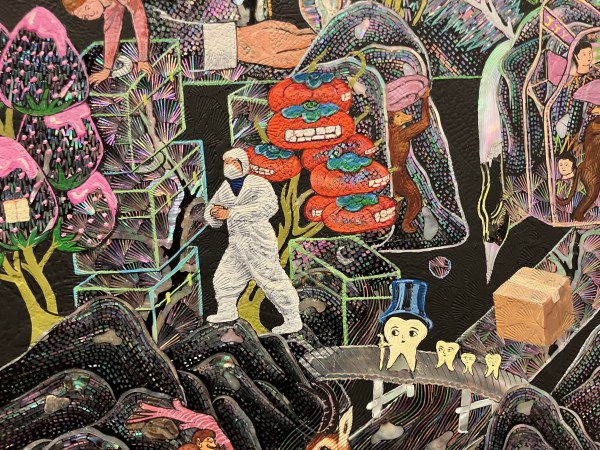
Eunjin Kim “Locations of God_Hordes of People” at Keumsan Gallery, Seoul, Booth 122
I almost walked right past Kim’s work distracted by the too-muchness of it. But fortunately I hesitated and was treated to a captivating artwork about everything. I was reminded of Hieronymus Bosch and the horrors of his Dante-inspired hellscapes with all manner of demons feasting on and torturing human souls amidst the backdrop of eternal fire. Or the dense cells of Chris Ware’s graphic novels. But we encounter an updated tableau of horrors and vignettes featuring vaguely familiar authorities like a group of figures in hazmat suits with laser guns trying to subdue a mythical dragon. Or a female figure doing something furtive while an oozing upside-down ice cream cone encroaches upon her.
The matte black backdrop encrusted with mother-of pearl gives the whole image an unsettling movement, like heartburn, or an earthquake in a snow globe brought to vivid life through the language of ancient Japanese lacquered screens or medieval tapestries, the age old dilemma of cultural collision between old and new, myth and history, sacred and profane. It’s the kind of work that each viewing invites another wildly complex story to emerge from its pictorial folds like dreams upon dreams, or a psychedelic journey through a cosmic drama where unicorns skewer bureaucrats attempting to impose order on the celestial. Kim beautifully articulates a universe in which the mundane human drama is interwoven with spiritual warfare. Whether we are pawns in the talons of uncaring deities, the mortal consciousness that animates their will, or the hands that move the primordial clock is open for debate.
 JOHN PREUS